Windows 98
Scientific Workstation Edition

Welcome to Jessica Syafaq Muthmaina's Portfolio Workstation.
Type password or click Log On to enter.
Welcome to Jessica Syafaq Muthmaina's Portfolio Workstation.
Type password or click Log On to enter.
        .  *  °  .  ✦  .  *  °  .  ★  .  *  °  .  ✧  .  *  °  .  ✦  .  *
     . ⁺ ₊ ⋆ ˚ ₊ ‧ ⁺ ₊ ⋆ . ✦ . ⋆ ⁺ ₊ ⋆ ˚ ₊ ‧ ⁺ ₊ ⋆ . ✦ . ⋆ ⁺ ₊ ⋆ ˚ ₊ ‧ ⁺ ₊ ⋆ .
      ★  .  *  °  .  ✧  .  *  °  .  ✦  .  *  °  .  ★  .  *  °  .  ✧  .  *
     ⋆.ೃ࿔*:・  .  *  .  ✦  .  *  .  ★  .  *  .  ✧  .  *  .  ⋆.ೃ࿔*:・

User Jessica Syafaq Muthmaina
Focus astrophysics and cosmology
Host M.Sc. UNIPD (Padova, Italy)
Base B.Sc. UGM (Yogyakarta, Indonesia)
Welcome to my personal digital space! I am Jessica Syafaq Muthmaina, an astrophysicist and researcher currently pursuing my Master of Science (M.Sc.) in Astrophysics and Cosmology at Universita degli Studi di Padova (UNIPD), Padova, Italy.
I previously earned my Bachelor of Science (B.Sc.) in Physics from Universitas Gadjah Mada (UGM) in Yogyakarta, Indonesia, concentrating on theoretical, computational physics, and observational astronomy.
My scientific research focuses on observational astrophysics, quasars, active galactic nuclei (AGN), positional stability analysis using VLBI time series, and frequency stability metrics via Allan standard deviation.
I love my computer! I use it for astronomical data processing, reduction, spectral analysis, LaTeX scientific typesetting, and Zettelkasten research synthesis in Obsidian.
Beyond physics, I am deeply engaged in community building, open knowledge sharing, and intersectional advocacy with Sadar Setara and Ruang Postulat in Garut, Indonesia.
Authors: Jessica Syafaq Muthmaina1, Ibnu Nurul Huda2, Dwi Satya Palupi1
1Department of Physics, Faculty of Mathematics and Natural Sciences, Universitas Gadjah Mada, Yogyakarta, Indonesia
2Research Center for Computation, National Research and Innovation Agency (BRIN), Bogor, Indonesia
Publication: IOPScience Journal of Physics Conference Series | arXiv: 2401.12325 [astro-ph.GA] | DOI: 10.1088/1742-6596/2773/1/012007
Abstract
The International Celestial Reference Frame (ICRF) plays an important role in astronomy and geodesy. The realization of ICRF is based on the position of thousands of quasars observed using the Very-Long Baseline Interferometry (VLBI) technique. Better quality of ICRF is achieved when the position of the quasars is stable. In this study, we aim to analyze the stability of one of the quasars in ICRF called 4C31.61 (2201+315). We performed VLBI data analysis by using Vienna VLBI and Satellite Software (VieVS) to get the position of the quasar. We also used the data of the quasar's position from the Paris Observatory Geodetic VLBI Center. We examined the stability of the quasar position by using the Allan standard deviation technique. We found that the quasar 4C31.61 (2201+315) has a stable position with the dominance of white noise across the majority of time scales.
Very Long Baseline Interferometry (VLBI) is an observational technique that uses widely separated radio telescopes to observe astronomical radio sources simultaneously. VLBI is the primary technique for realizing the International Celestial Reference Frame (ICRF-3) through high-precision positional monitoring of extragalactic radio sources. Positional stability is an essential prerequisite for reference quasars to prevent distortion in celestial reference frames.
We analyzed 33 years of VLBI observation data (1990–2023) comprising 6,342 sessions. Quasar 4C31.61 positions in Right Ascension ($\alpha$) and Declination ($\delta$) were derived using Vienna VLBI Software (VieVS) with ICRF-3 and ITRF-2020 reference frames, and compared against Paris Observatory Geodetic VLBI Center data ($\alpha = 330.8123990589822^\circ$, $\delta = 31.7606305185240^\circ$).
Overlapping Allan Standard Deviation $\sigma^2(\tau)$
where $M$ is the number of windows, $\tau = m\tau_0$ is the time scale ($\tau_0$ sampling interval), and $\bar{y}$ is the sample mean over interval $\tau$.
Noise classification is determined by the slope $S$ in logarithmic Allan variance plots: White Noise (Stable): $S < -0.25$; Flicker Noise: $-0.25 \le S \le 0.25$; Random Walk (Unstable): $S > 0.25$.
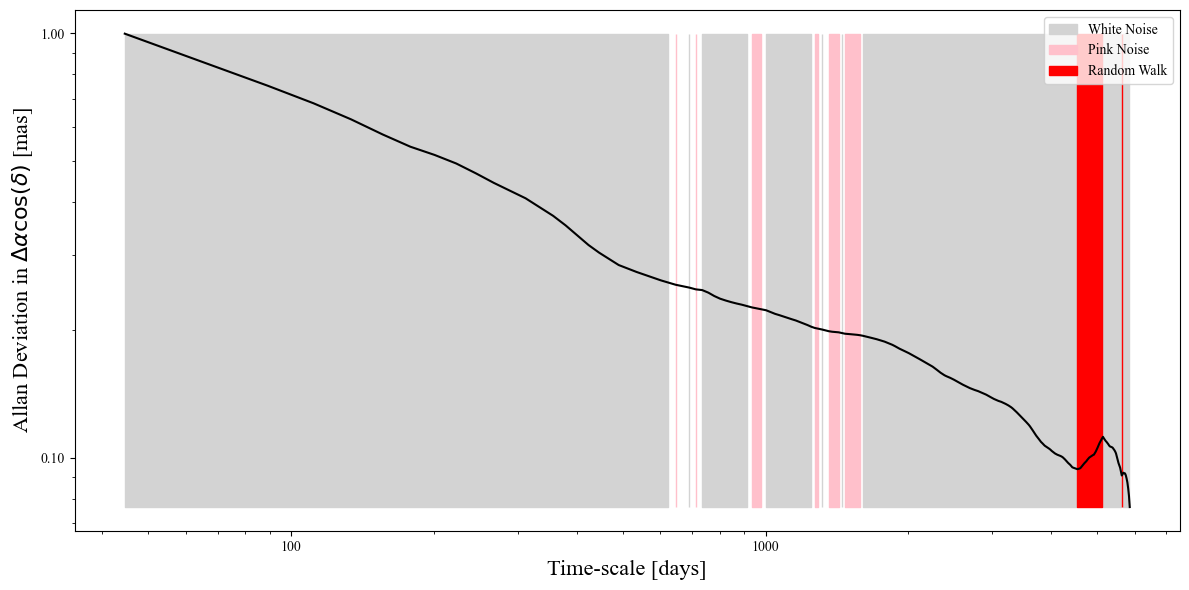
(a) VieVS Analysis — $\alpha \cos \delta$
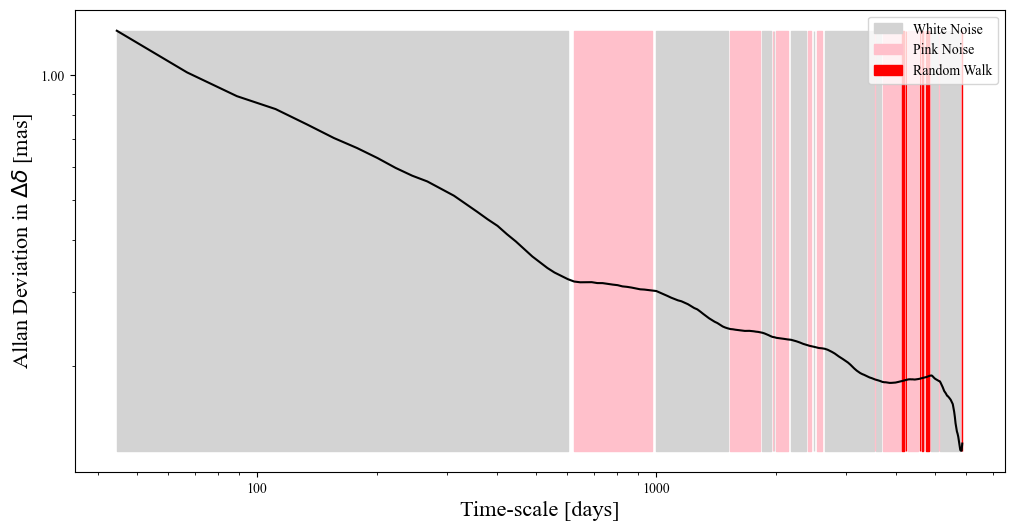
(b) VieVS Analysis — $\delta$
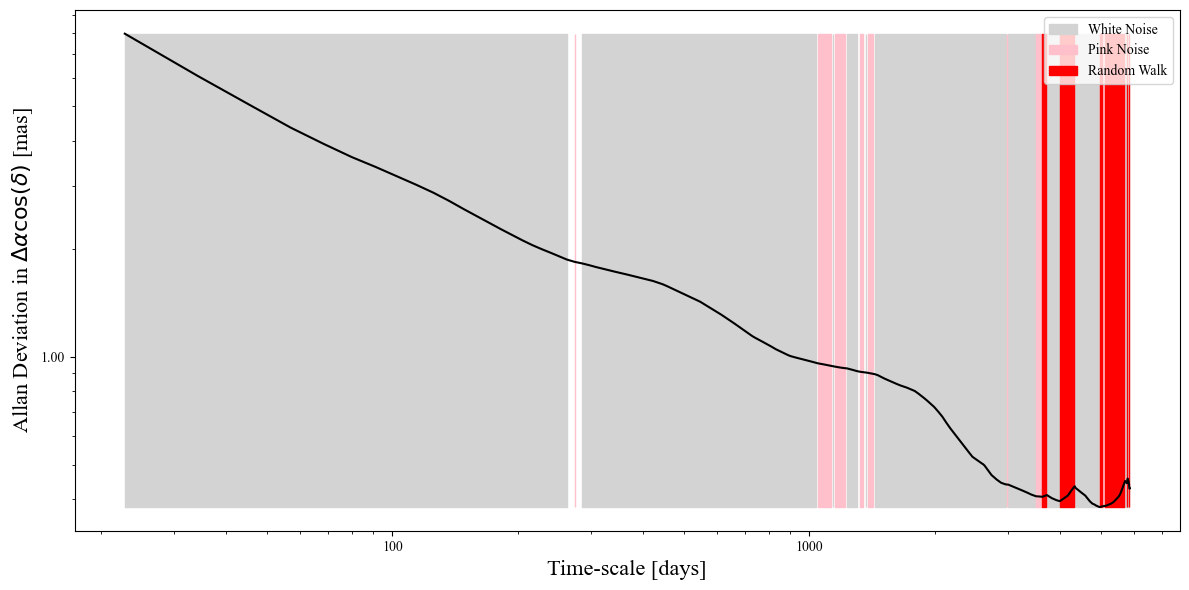
(c) Paris Observatory GVC — $\alpha \cos \delta$
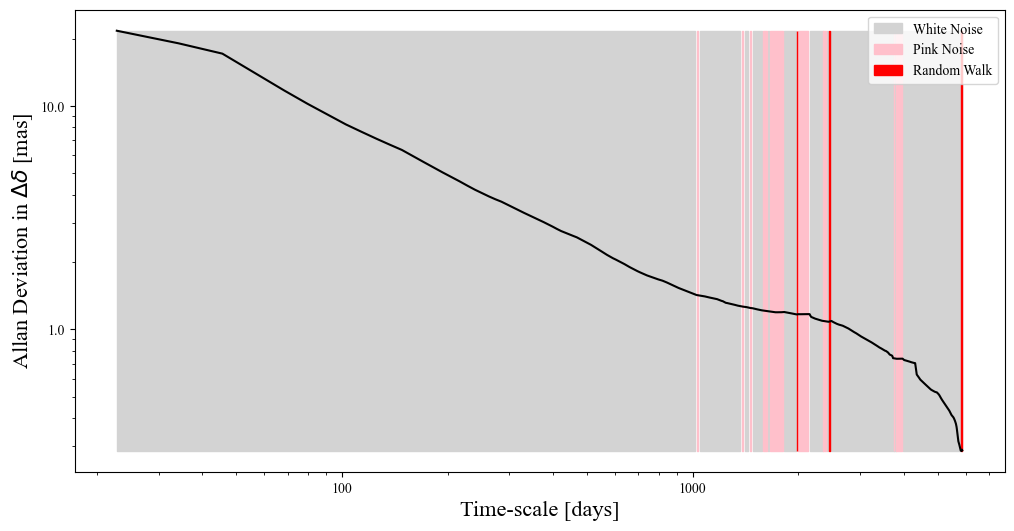
(d) Paris Observatory GVC — $\delta$
The Allan deviation plots demonstrate that white noise dominates across short time scales, confirming that Quasar 4C31.61 (2201+315) maintains high positional stability suitable for ICRF reference frame realization. For long time scales, random walk noise is observed, which can be attributed to plasma jet ejections from the quasar nucleus or potential Binary Black Hole (BBH) orbital motions.

stefano.ciroi@unipd.it
ibnu.nurul.huda@brin.go.id
Jessica Syafaq Muthmaina | Observational Astrophysics
A commitment to thorough observational data analysis, precise error quantification using methods like Allan variance, and seeking empirical truth in cosmic structures.
Belief in accessible research, open-source computational tools, and communicating complex astronomical discoveries engagingly to public audiences.
Fostering inclusive academic spaces and active grassroots community advocacy through Sadar Setara and Ruang Postulat.
Bridging academic perspectives between Indonesia and Europe, connecting UGM, UNIPD, and international research facilities.